Voyager 2.5 - 39 hours of Ocean Sailing Data
Power Consumption
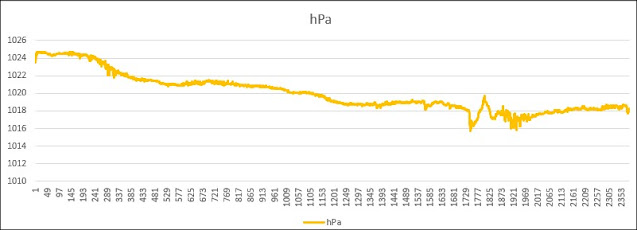
The actual rate of voltage drop would increase as voltage drops.
![]() |
| Voyager 2.5 undergoing lake trials in 15 to 20 knots. |
![]() |
| Planned course from Torquay heading east to Cape Schanck and into Western Port |
| Voyager 2.5 on Torquay beach just prior to launch 7:30am 11/7/2022 |
![]() |
| Sailing well past the Cape Schanck waypoint heading into Western Port at 6:30pm 12/7/2022 - 35 hours |
![]() |
| Voyager stopped sailing just before reaching the the West Head waypoint 10:59pm 12/7/2022 - 39 hours, then drifted back out to sea. |
![]() |
| Voyager drifted east for another day coming ashore on rocks at Redcliff Head, Philip Island at 9pm 13/7/2022 |
| View from Pyramid Rock looking west toward Flinders, showing Redcliff Head, at around the time of coming ashore. |
| Voyager 2.5 as found on Thursday morning at low tide, perched on a rock. |
After Voyager made an ocean voyage in May 2021, she was retired, and focus shifted to Voyager 3.0. But after some thought it was decided to refurbish and upgrade Voyager 2.0 to become Voyager 2.5 with aim of completing an ocean voyage.
The main features of the upgrade of Voyager 2.5 are:
| Voyager 2.0, with a similar setup used for the ocean voyage in May 2021 |
![]() |
| Voyager 2.0 refurbished as 2.5, under-going final lake trials prior to going to sea, June 2022. |
| Voyager 2.5 on Torquay beach, preparing to go to sea |
![]() |
| Voyager 2.0 with Sail Controller V1 fitted in the Wingsail |
![]() |
| Prototype Wingsail Controller using Bluetooth 4 |
Voyager Sail Controller V0 using Bluetooth 4 - August 2018
![]() |
| Voyager Sail Controller V1 using Bluetooth 4 - March 2019 |
![]() |
| Voyager Sail Controller V2 using LoRa Radio - May 2019 |
| First Wingsail Design for Voyager 3 - CP is too far forward. |
Its November 2021 and most lockdown restrictions are gone now.
Today was the first opportunity to get on the local lake for the maiden voyage of Voyager 3.0.
It was good to get the boat in the water for the firs time, but it was inconclusive due to turbulent winds coming through the nearby trees making course keeping difficult.
I need to pick a day on the lake with north-westerly winds to get the cleanest winds for testing.
| Voyager 2.0 shortly after recovery |
| Remainder of Mast showing the brittle fracture at deck level |
![]() |
| Testing of the remainder of the mast showing ductile failure. |
| Brilliance 920ml Container with the 5ml water acquired during the 76 hours at sea. |
![]() |
| The course from Torquay to Pt Leo. |
![]() |
| Pre-Launch |
| Sunrise on May Day with Voyager a few kilometres into the voyage, still in range of the LoRa telemetry. |
![]() |
| Voyager 2.0 sailed well for 32 hours in Bass Strait. |
Voyager 3.0 Design Goals
Voyager 3.0 is next in the series of the Voyager sailing drones.
The main aim for Voyager 3.0 is to be able to operate at sea for about 14 days or longer.
Voyager 2.0 can only operate for about 4 days on battery. Voyager 3.0 will include solar charging with the aim of allowing continuous operation. An endurance of 14 days at sea should allow for a rounding of King Island from the Victorian coast and back.
Tests of solar charging rigs have suggested that around 20 solar cells as a minimum are needed for reasonable charging levels for a 2S battery powering Voyager.
The dimensions of Voyager 3.0 have been entirely dictated by the compromise of minimum size for ease of handling, versus adequate deck space to accommodate enough half-size solar cells to support reasonable charging levels.
Overall dimensions of 1800mm length and 350mm beam were chosen to allow possibly up to 23 half-size solar cells to be accommodated.
![]() |
| Commence Construction of Voyager 3.0 with the Stringer, shown partially completed here |
![]() |
| Preparing to glue the first foam sheet on the stringer. |
![]() |
| Part way through cutting the foam sheets using a hotwire cutter. |
![]() |
| Commence shaping the laminated foam hull. |
![]() |
| Part way through shaping of the foam core hull |
| Voyager 3.0 with glassing finished, ready for fit-out, along side Voyager 2.0 |
Note: This is part of the ongoing development of a low cost autonomous oceangoing sailing drones, utilising a self-trimming wingsail. This is the Voyager series of sailing drones.
![]() |
| Checks done. Ready to go again. |
When waypoints are only a few hundred metres away, it is simple to steer a course representing the Bearing to Waypoint (BTW) and you will typically arrive there, having followed closely along the rhumb line.
When the waypoint is many miles away, and the steering method is to steer the BTW, then it is quite likely that the vessel will deviate great distances from the rhumb line over a period of time.
This was one of the problems encountered during the last voyage across Port Phillip in March 2020.
The main software design change since then was to continual measure the Cross Track Error (CTE) and use this to add a proportional course correction to the BTW to encourage the vessel to return to the rhumb line. The amount of course correction to apply is calculated as the ratio of CTE to CTEMax (where CTEMax is defined in the mission as half width of the corridor to the next waypoint), multiplied by gain constant.
Hence the simple course to be steered is: BTW - CTE/CTEMax x Kc
Note: This is all assuming that a course can be laid directly to the waypoint without tacking. If tacking is required, then a whole set of different rules apply which are beyond the scope of this article.
![]() |
| Satellite Tracking Plot |
The new method of steering using CTE combined with BTW appears to work well.
I've tried to sail across Port Phillip twice now, and failed both times due to human intervention.
I'll need to add signage suggesting to "KEEP CLEAR" or head out to the open ocean where there's less chance of meeting other vessels.
| Port Arlington - Home Port for the last vessel to "rescue" Voyager |
It is August 2020 in Melbourne, Australia. We haven't been allowed to travel any distance for many weeks now, so there's no sailing trials permitted for hobbyists. So no chance to test the new sail, or the new LoRa telemetry system now installed on Voyager 2.0.
This allows time to start looking ahead to Voyager 3.0, which will be a scaled up version of Voyager 2.0 at 2m LOA, and about 0.5m in beam.
The intention of Voyager 3.0 is that it has a large enough deck space to accommodate enough solar cells to allow for missions of indefinite duration. Currently the battery capacity of Voyager 2.0 is about 80 to 120 hours (4 or 5 days). The Wingsail battery life is about 200 hours (8 days).
The Solar Cells in use are the Sunpower C60 cells. These are a light weight and flexible (within limits) and can be sliced up. They can provide over 3A at around 0.5V in direct sun. I'm currently slicing them into thirds, which can yield around 1A at 0.5V per cell in direct sun, and of course when connected in series, the three cells can yield 1.5V at 0.5A.
The image below shows a typically test set up for working out the basic parameters of the charging setup.